Beyond Clean Label: The Hurdle Technology Redefining Preservation in Artisanal Sauces

Category: Process Technology Author: Aramiz Molina Proposed publication date: September 9, 2026
In 2026, clean label has matured: it's no longer about removing one additive from the ingredient list, but about redesigning the entire preservation system. Multi-hurdle technology offers the scientific framework artisanal hot sauce brands need to meet market demands without compromising safety or shelf life.
How many products labeled "clean" on the market are reformulating without replacing the functional role of what they removed? That question — posed in technical terms by formulation teams at companies like Ingredion — sums up the biggest risk of the clean label era in sauces and condiments. And the answer, in 2026, is pushing serious artisanal producers to go beyond the label: toward preservation science.
The Market Sets the Direction — But Demands Technical Rigor
The global artisanal hot sauce market is growing at a pace few sectors within the condiment universe can match. According to Fortune Business Insights data, the U.S. hot sauce segment will grow at a compound annual rate of 7.58% through 2032, from a base of over $1 billion in 2024. Within that landscape, artisanal sauces and craft chili crisp lead the pack: analyses published in August 2026 estimate their CAGR between 7.2% and 8.4%, the highest within the entire condiment category.
But growing in this market comes with a tacit requirement that appears in no growth forecast: the label. More specifically, what doesn't appear on it.
Clean Label in 2026: From Simple Task to Full Redesign
For years, "clean label" was synonymous with a relatively straightforward task: removing unpronounceable names from the ingredient panel, swapping synthetic dyes for natural extracts, pulling sodium benzoate. That stage, according to Innova Market Insights, is now behind us.
In 2026, clean label reformulation has entered what Food Ingredients First describes as an "era of full redesign." Ingredion puts it precisely: "the question is no longer whether the product has a clean label, but which formulation decisions matter most to the consumer." Demand has fragmented into at least three vectors coexisting in the same market: buyers who prioritize the absence of additives, others who demand verifiable natural-origin ingredients, and a growing third group asking for environmentally responsible positioning.
What hasn't changed is the cold reality of the technical problem: removing an ingredient without replacing its function is a recipe for safety or sensory failure. In hot sauces — where the balance of acidity, sweetness, salt, and heat is precisely the product — a careless reformulation can destroy a brand's value proposition in a single shelf iteration.
Hurdle Technology: The Scientific Framework for the Artisanal Producer
This is where preservation science offers the most elegant answer available: hurdle technology.
The principle is simple in concept and sophisticated in execution: instead of relying on a single preservative agent at a high dose, a system is designed where several factors — pH, water activity (Aw), temperature, packaging atmosphere, and natural antimicrobials — work synergistically. Each hurdle operates at moderate levels that would individually be insufficient; together, they create an environment inhospitable to microbial growth, sustained over time and with a lower additive load on the label.
For artisanal hot sauce, this framework is especially powerful because the recipe's own characteristic ingredients can already function as active hurdles. The acidity of fermented chile, vinegar, salt, and spices aren't just flavors: they're functional hurdles many producers are already leveraging without having documented them as such.
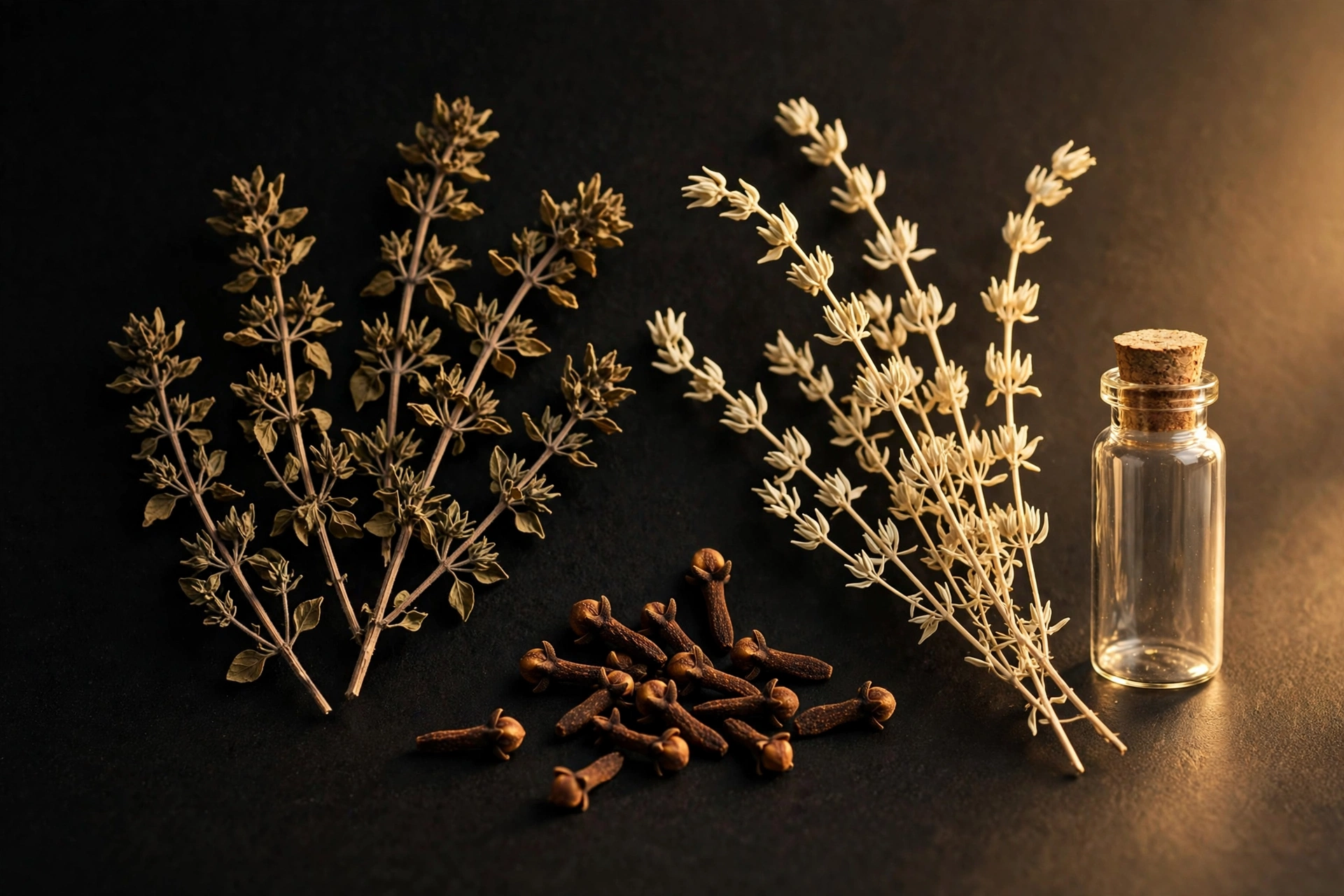
Research published in 2026 in the scientific journal Foods by researchers at Universidad de las Américas Puebla offers directly applicable evidence: combining natural antimicrobials derived from spices — thymol (present in thyme and oregano), carvacrol (oregano), and eugenol (clove) — with potassium sorbate doses below 32 ppm maintains effective inhibition against Listeria innocua (a non-pathogenic model strain used as a safe stand-in for L. monocytogenes in lab testing) and Salmonella, comparable to conventional doses of the preservative used alone. The synergy between plant-derived compounds and conventional preservatives allows for a significant reduction in total chemical load without sacrificing microbiological safety.
For brands already working with recipes that include oregano, clove, or thyme, this isn't a radical reformulation: it's reframing what's already in the pot as part of a documented, scientifically validated preservation system that can be communicated on the label to distributors, retailers, and importers.
E-Commerce: The Channel Where the Label Becomes a Sales Argument
If there's one space where clean label stops being a marketing aspiration and becomes a concrete conversion lever, it's the digital channel. And in 2026, that channel is no longer secondary.
According to US Census Bureau data, U.S. e-commerce sales grew 12.2% in the second quarter of 2026 compared to the same period the previous year. The food and beverage segment grew 8.1% in that same period, adding more than $775 million to the channel. And within the sauce and condiment category, D2C and e-commerce channels are advancing the fastest: market analyses published in August 2026 estimate their compound growth rate at 9.8%, higher than any other distribution channel.
In the digital environment, the buyer can read every ingredient before adding to cart. The distributor can verify the full panel before placing their first order. There's no shelf-level visual mechanism — package shape, gondola position — to compensate for a label that creates friction. The text does all the work.
The implication is direct for the artisanal producer: the claim of "with natural-origin spices as part of the preservation system" isn't just a quality statement. It's conversion content. It's what differentiates a brand on an Amazon product page or in a pitch to a regional distributor through Faire.
The Mexican Context: Rising Production, an Open Export Window
Mexico's national sauce production recorded 15.8% growth in May 2026 compared to the same month the previous year, according to the agrifood industry tracking report from the Secretariat of Agriculture (SADER/DGSIAP). In value, production exceeded 800 million pesos, with growth both month-over-month and year-over-year, cementing sauce as one of the most dynamic segments of the preserves industry.
The Mexican sauce and condiment market — estimated at $1,036 million in 2025 — projects sustained growth of 5.81% annually through 2034. And on the export front, there are positive signals: Mexican exports to Canada grew 20.2% in the first half of 2026 according to Banco de México, and states like Puebla are already reporting regional brands surpassing $1 million in shipments to the United States.
For the Mexican manufacturer who exports — or is considering it — clean label built on hurdle technology offers an additional regulatory benefit: plant-derived ingredients don't require the same declarations as synthetic additives under FDA regulation. Most spices are classified as GRAS (Generally Recognized as Safe). The path to certification and bilingual labeling is shorter when the preservation system is built on ingredients that both Mexican regulation (NOM) and the FDA already fully recognize.
Practical Application: What This Means for Your Role in the Chain
- Producer and co-packer: Documenting the hurdle system already present in the recipe is the mandatory first step. pH, Aw, salt concentration, and the presence of spices with proven antimicrobial activity may already constitute a technically valid hurdle system. This isn't about reformulating from scratch — it's about auditing what's already in production and formalizing it with scientific backing that's communicable to demanding buyers.
- Distributor and importer: The sophisticated buyer in the United States, Canada, or Europe is already asking technical preservation questions. "Why does it last X months without refrigeration?" needs an answer that's more than "we added a preservative." Documentation of the hurdle system is a due-diligence argument for the distributor who wants to carry an artisanal Mexican line with confidence.
- Investor and foodservice: The cost of reactive reformulation — when a product is rejected by a retailer or institutional buyer over its ingredient list — always exceeds the cost of designing the system well from the start. Brands that integrate clean label into their process technology by design carry lower risk of forced reformulation and greater long-term clarity in their value proposition.
In Closing: The Questions Worth Asking
The convergence between the scientific rigor of hurdle technology and clean label market expectations isn't a future trend — it's happening right now, and the artisanal producers who master it first will hold a technical and commercial advantage that's genuinely hard to replicate.
Is your current preservation system documented as a set of validated hurdles, or does it still rely on the maximum dose of a single preservative? Which spices or ingredients in your recipe might already be performing an antimicrobial function you haven't formally quantified? Do your technical team and your commercial team speak the same language on this when they sit across from a buyer?
Sources: Fortune Business Insights · Food Ingredients First / Innova Market Insights / Ingredion · Hernández-Figueroa et al., Foods (2026), Universidad de las Américas Puebla · US Census Bureau / Practical Ecommerce · SADER-DGSIAP (Mexico's Secretariat of Agriculture) · Banco de México · market analyses published August 2026.
— Aramiz Molina, Blog B2B Día de Sazón

Part of the Día de Sazón team, focused on manufacturing, sourcing, and B2B business development.
Get new blog articles
Manufacturing, sourcing, and market trends straight to your inbox. No spam.