From Home Kitchen to Industrial Plant: What Actually Changes (and What Shouldn't)
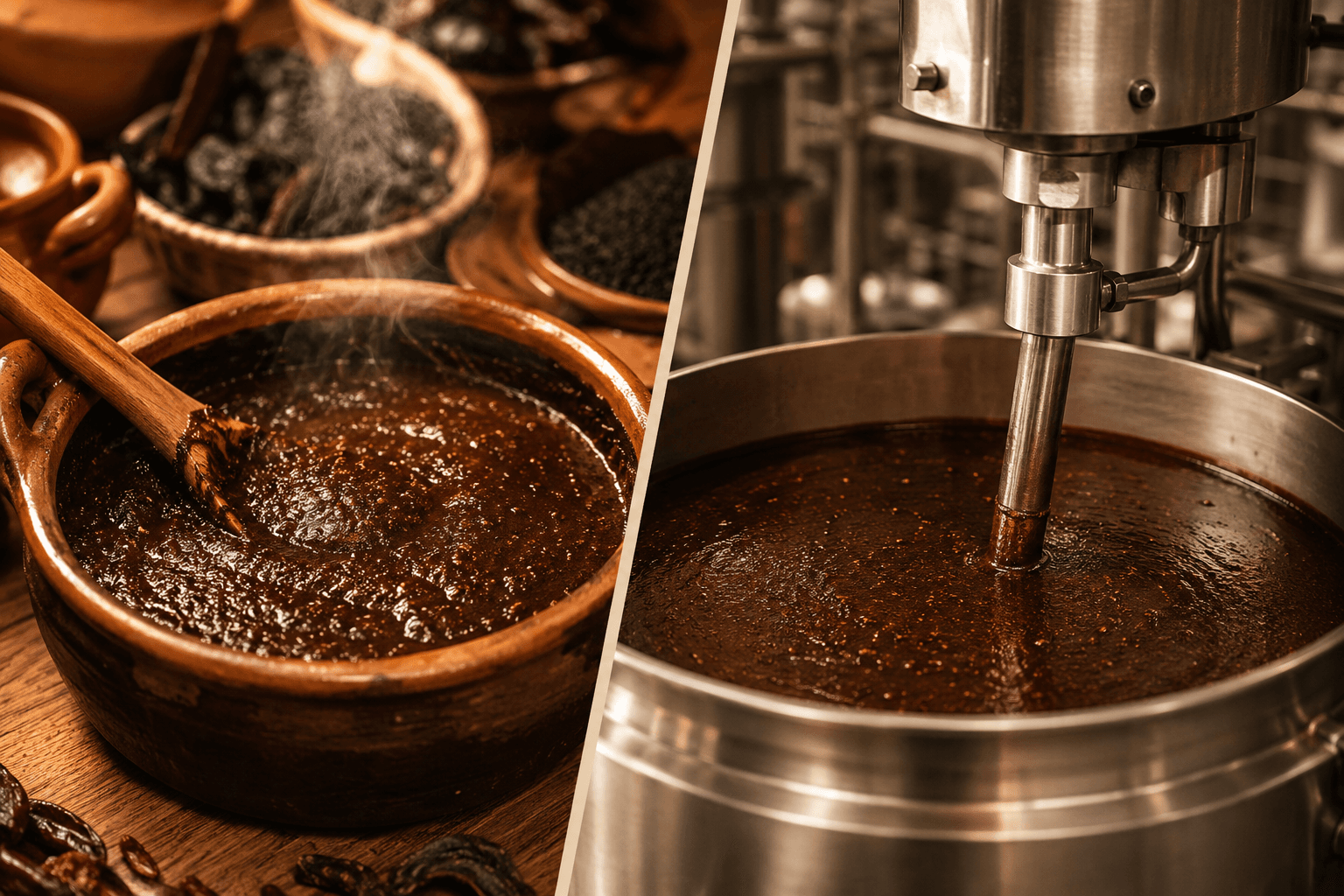
There's a myth worth breaking right away: scaling a recipe isn't about buying a bigger pot.
When a recipe lives in a home kitchen, the cook adjusts everything in real time — a little more salt, an extra minute of cooking, the flame turned down slightly because "the chile is stronger today." That constant capacity to adjust is exactly what makes an artisanal sauce taste the way it should. And it's exactly what disappears the moment you go from 5 liters on the stove to 500 liters in an industrial tank.
The question that actually matters isn't "how do we make more?" It's: how do we translate a cook's judgment into parameters a plant can reproduce, batch after batch, without anyone standing over a spoon tasting for doneness?
The three variables that actually change when you scale
Flavor consistency. In a home kitchen, consistency lives in the cook's experience. In a plant, it has to live in numbers: pH, degrees Brix, exact cook times. The number doesn't replace the flavor — it's the only way to guarantee the flavor repeats identically in batch 1 and batch 500.
Food safety. There's a world of difference between "this tastes great today" and "this is safe to eat 12 months from now, sitting on a shelf." That gap gets closed with what the industry calls hurdle technology: combining acidity, water activity control, and thermal treatment so that, together, they make the product shelf-stable without needing artificial preservatives. It's science applied to something that was always done "by feel" — and honestly, it's one of the most delicate steps in the whole process.
Equipment selection. Here's one of the most common mistakes I've seen in the industry: assuming the right equipment is "whatever's biggest available." It isn't. The right equipment is whatever preserves the original process — for example, a mill that doesn't generate excess heat and end up overcooking ingredients before their time, losing aroma and texture along the way. Choosing machinery for artisanal foods is, at its core, an exercise in preservation engineering, not just volume.
The mistake the industry keeps making
Most brands that fail at scaling don't fail from lack of ambition — they fail because they treat the industrial process as an obstacle to clear as fast as possible, instead of a precision tool worth understanding deeply. They rush to produce volume before mastering the parameters, and the result is an inconsistent product: delicious in the pilot batch, disappointing in the commercial one.
The discipline of doing it right — measuring, documenting, validating before scaling — isn't bureaucracy. It's what separates a brand built to last from one that burns out in its first year.
How we're doing it at Día de Sazón
At Día de Sazón, we started from a recipe with generations behind it — the one from the family grandmother behind the brand — and the challenge was never "make it bigger." It's been making sure a jar produced at industrial scale tastes exactly like the one that comes out of her clay pot.
That means working with a certified manufacturing partner who understands food processing as well as they understand why this recipe isn't up for negotiation. It means measuring every parameter with the same seriousness she uses to judge "the point" of a stew by eye. And it means every equipment decision gets made with flavor first, efficiency second.
The end goal is simple to say and hard to pull off: a jar in Chicago should taste exactly as authentic as one in Zapopan.
What's been hardest for you when scaling?
If you're in food manufacturing, you've likely lived your own version of this challenge — maybe with a different ingredient, a different recipe, a different technical hurdle. We'd love to hear about it: what's been the biggest obstacle you've faced taking an artisanal product into industrial production?

Part of the Día de Sazón team, focused on manufacturing, sourcing, and B2B business development.
Get new blog articles
Manufacturing, sourcing, and market trends straight to your inbox. No spam.